Independent reference · No manufacturer affiliation 17 interfaces documented · DC–40 GHz · 50 & 75 Ω Corrections welcome →

A field reference · Miniature RF interconnect

SMALL CONNECTORS. BIG SIGNAL.

Green Button is our running file on the small stuff: MMCX, MCX, U.FL and its IPEX and MHF relatives, plus SMA, SMB and SMP. Who built each one, and what problem they were sick of at the time. What actually survives on a bench versus what the datasheet politely declines to mention. How many mating cycles you get before return loss starts drifting on you.

U.FL still irritates us. Thirty cycles if you are gentle, and gentle is doing heavy lifting in that sentence.

Then the part that eats an afternoon: pairs that look consanguineous enough to mate, sit flush, and still do nothing, because one side is a 75-ohm part masquerading as a 50, or the detent geometry misses by a whisker nobody bothered to print on the drawing.

Find your signal
MMCX MCX U.FL / IPEX MHF I–4L SMA RP-SMA SMB SMP W.FL AMC UMCC 1.13 mm COAX RG-178 RG-316 MMCX MCX U.FL / IPEX MHF I–4L SMA RP-SMA SMB SMP W.FL AMC UMCC 1.13 mm COAX RG-178 RG-316

01 / What this is

A reference, not a catalogue.

Green Button is an independent technical reference covering RF interconnect at its smallest end. We sell nothing. The site got started because one 2.0 mm footprint turns up in a dozen manufacturer PDFs, each one trademarked into a different name, and somebody had to keep score.

What you get: what each interface is, where the mechanical story and the electrical story stop agreeing, and which cross-references hold once a real part goes on a real bench. A figure lifted from a published spec sheet says so, with the vendor's name attached. A figure we measured ourselves arrives with the receipts: which analyzer, which cal kit, which cable assembly, what the ambient was doing.

Page wrong? Gone stale because the drawing got revised and nobody told us? Say something. Errata move this reference forward faster than anything else we do.

Miniature coaxial connectors

02 / Interface families

Six families worth knowing.

Nearly every small RF link lands on one of these. Connection speed, retention, stack height: pick the two you care about and let the third one go.

Snap-on · 50 Ω
MMCX

Micro-miniature snap-on with a detent you feel seat. Around 45% smaller than MCX, which wins it a spot on boards where real estate got expensive, and the joint still shrugs off a technician tugging the cable during build.

  • FrequencyDC–6 GHz
  • Mating cycles~500
  • CouplingSnap-on
Snap-on · 50 / 75 Ω
MCX

Came out of the 1980s, standardized under CECC 22000. Inner contact geometry borrowed straight from SMB at roughly a third of the bulk. One of the few small interfaces you can source in 75 Ω without going on a hunt.

  • FrequencyDC–6 GHz
  • Mating cycles~500
  • StandardCECC 22000
Ultra-miniature · 50 Ω
U.FL

Hirose's trademark on the 2.0 mm receptacle that owns module-to-antenna hops. Amphenol AMC, Molex UMCC and I-PEX MHF I all describe that same mating footprint wearing their own badge.

  • FrequencyDC–6 GHz
  • Mated height2.5 mm
  • Mating cycles~30
Low profile · 50 Ω
MHF

I-PEX's line, MHF I through MHF 4L. Each step down buys you height and sells off interchangeability. MHF 4 comes in at 1.2 mm mated and shares nothing with MHF I except nomenclature.

  • FrequencyDC–15 GHz
  • Mated height1.2–2.5 mm
  • Cable0.81–1.37 mm
Threaded · 50 Ω
SMA

The threaded end most small assemblies terminate into. Slower to make up than any snap-on, and the only entry here that arrives with a torque spec you are meant to honor.

  • FrequencyDC–18 GHz
  • Torque0.6 N·m
  • Mating cycles~500
Push-on · 50 Ω
SMP

Blind-mate push-on for stacked boards and test fixtures. Full, limited and smooth-bore retention variants let you dial insertion force position by position across an array.

  • FrequencyDC–40 GHz
  • RetentionFull / limited / smooth
  • Mating cycles100–1000
17
Interfaces documented
1.2 mm
Smallest mated height
40 GHz
Top of the range covered
30–1000
Mating cycle spread

03 / From the notebook

Explainers, comparisons and data.

Pieces on the parts of this technology that datasheets tend to skip.

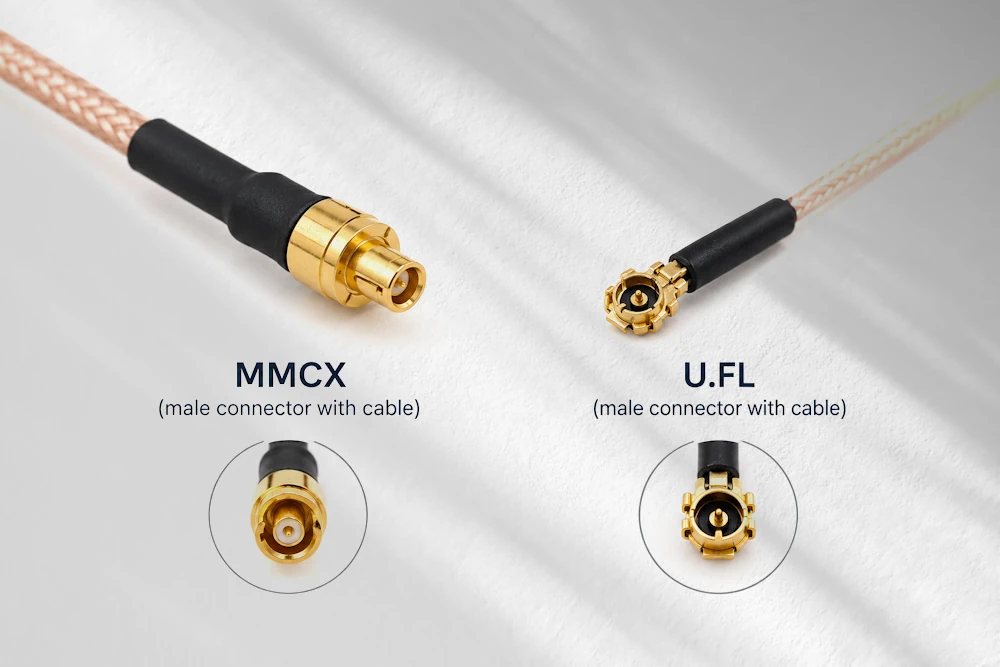
MMCX and U.FL cable assemblies

Cable assemblies for MMCX and U.FL: choosing the right coax for the job

Picking a connector is the easy part. The coax dangling behind it is where most RF headaches actually live, and if you've ever chased a mysterious 3 dB loss through a board revision, you already know this. Here's a working guide to matching cables for MMCX and U.FL builds, without the guesswork.
Gold and nickel connector plating

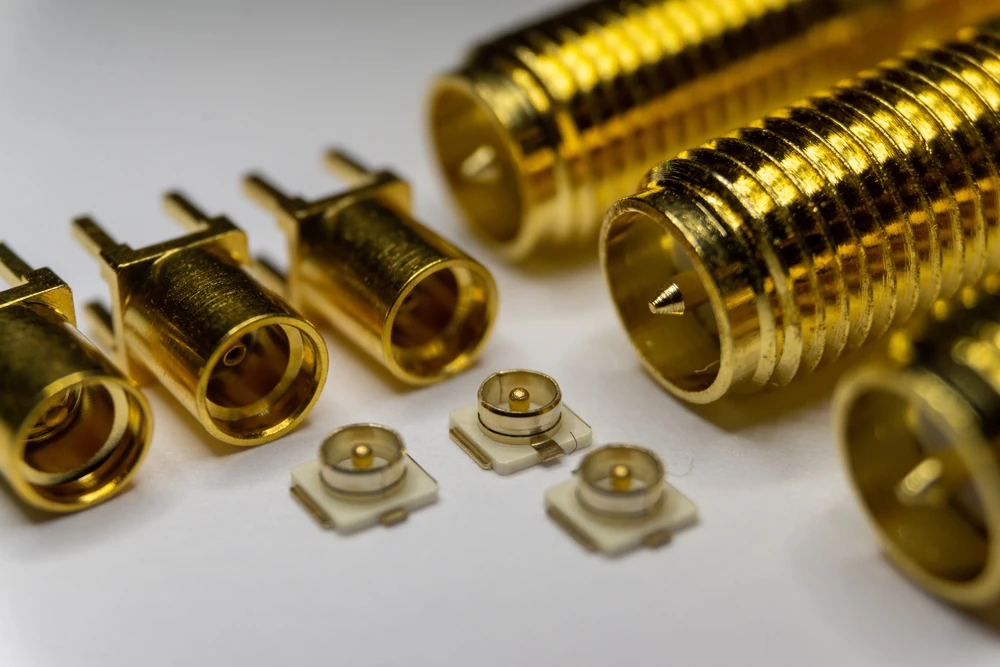
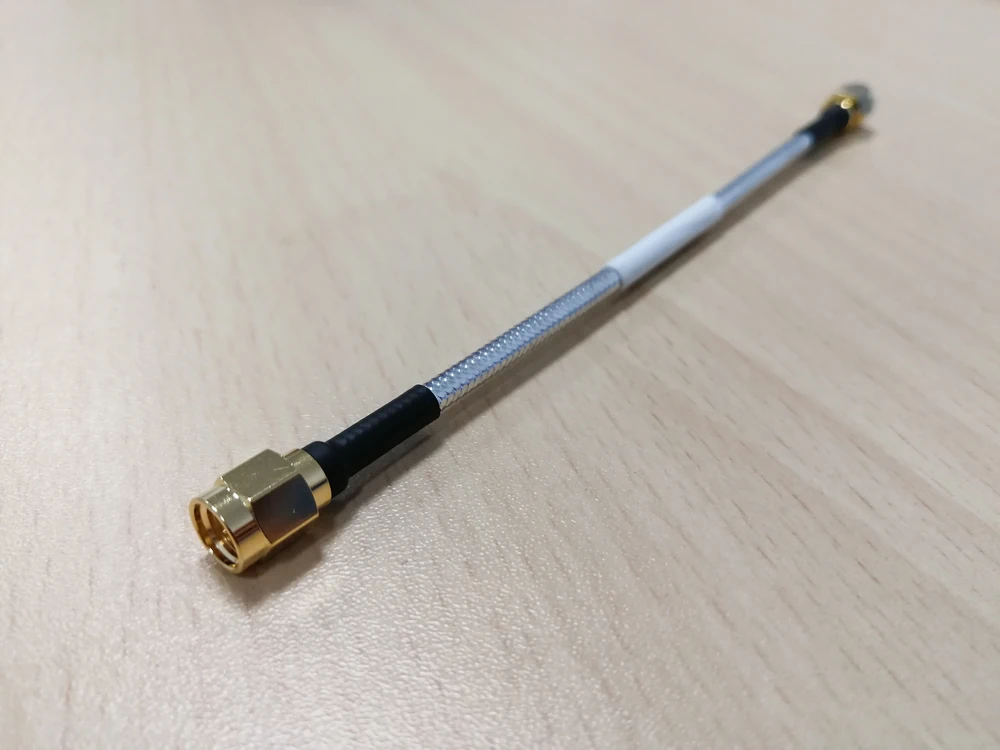
Connector plating, materials, and wear: why gold versus nickel matters in tiny RF parts

Here's a fact that surprises people who don't spend their days squinting at connector datasheets: the tiny gold-colored ring on your MMCX or SMA jack is often thinner than a soap bubble. Seriously. And that microscopic layer decides if your connector survives fifty matings or five thousand. It also decides if your signal stays clean or starts drifting into weird, hard-to-diagnose noise territory.

Intermittent versus permanent connector faults

Detecting intermittent vs permanent connector faults in wireless products

Here's the deal: a connector that fails once and stays dead is annoying but honest. A connector that fails only when someone breathes near it, walks by with a coffee, or the temperature drifts three degrees? That's the one that'll ruin your week. This piece walks through how to tell the two apart, using tools you probably already have on the bench, plus a few you should buy if you're serious about miniature RF work.

04 / Where they appear

The devices this technology sits inside.

Small RF interconnect hides. Here is where it earns its keep.

IoT & wireless modules

U.FL and MHF jumpers hauling signal twenty millimeters from a radio module to a chip or patch antenna.

Automotive telematics

FAKRA-to-MHF transitions inside head units and antenna modules, where vibration kills more joints than everything else combined.

Medical telemetry

Sealed, traceable assemblies in wearables and implant-adjacent kit, built on the understanding that nobody opens the joint again.

Test & measurement

SMA and SMP fixtures where holding the same numbers across thousands of insertions beats saving millimeters.

05 / Common misconceptions

Three things people get wrong.

Three beliefs fill our inbox.

“U.FL and MHF are the same thing.”

Half rightU.FL, MHF I, AMC and UMCC share a footprint. MHF II, III and 4 walk away from it, and MHF 4 keeps the family name and nothing else.

“If it mates, the impedance must match.”

MCX says otherwise50 and 75 Ω MCX parts look identical in the tray and mate happily. The mismatch surfaces weeks later as return loss nobody can pin to a part number.

“An adapter is electrically free.”

NeverEvery adapter is two connectors plus a short line doing an impression of nothing. Measured cost runs from 0.05 dB to north of 0.3 dB.

06 / Stay current

We tell you when the reference changes.

Fresh comparison data, cross-reference revisions, corrections. Once a month, give or take. Nothing is sold here, so you are not sold either.